
1. Cov ntaub ntawv kev nyab xeeb
Welding and cutting activities can be hazardous. Always follow proper safety precautions to prevent injury. This helmet provides eye and face protection during welding and cutting operations. It is crucial to use additional personal protective equipment (PPE) as recommended for your specific task.

Daim duab 1: Essential Personal Protective Equipment for Welding and Cutting. This infographic illustrates the importance of wearing safety glasses, welding gloves, a welding jacket, appropriate pants, safety boots, and ear protection in addition to the welding helmet.
General Safety Guidelines:
- Kev Tiv Thaiv Qhov Muag: Always wear approved safety glasses (ANSI Z87.1 compliant) under your welding helmet. The auto-darkening lens protects against arc flash, but safety glasses provide impact protection.
- Kev tiv thaiv taub hau: If required, wear a cap or other head covering to protect your head and neck from sparks and heat.
- Kev Tiv Thaiv Tes: Use welding gloves to protect hands from heat, sparks, and electrical shock.
- Kev tiv thaiv lub cev: Wear a flame-resistant welding jacket, long-sleeved shirts, and pants without cuffs to prevent sparks from entering.
- Kev tiv thaiv ko taw: Wear steel-toe boots or other protective footwear.
- Kev Tiv Thaiv Hnov: Use earplugs or earmuffs to protect against loud noise.
- Qhov cua: Ensure adequate ventilation to avoid inhaling hazardous fumes.
- Tshawb xyuas cov cuab yeej: Before each use, inspect the helmet for damage, cracks, or loose parts. Replace any damaged components immediately.
2. Kev teeb tsa thiab kev hloov kho
Proper setup ensures comfort and maximum protection. Follow these steps to prepare your welding helmet for use.
2.1 Headgear Adjustment
Adjust the headgear to fit snugly and comfortably on your head. The helmet should stay in the raised position when not welding and easily drop into the working position with a nod of your head.
- Kev kho qhov loj me: Rotate the knob at the back of the headgear to adjust the circumference for a secure fit.
- Top Strap Adjustment: Adjust the top strap to position the helmet correctly on your head, ensuring the viewing area is at eye level.
- Kev kho qhov deb: Adjust the distance between the helmet shell and your face using the side knobs. This prevents the helmet from hitting your nose or chin when lowered.
- Tilt Adjustment: Some headgears allow for tilt adjustment. Set it to your preferred angle for optimal viewhauv thiab kev nplij siab.
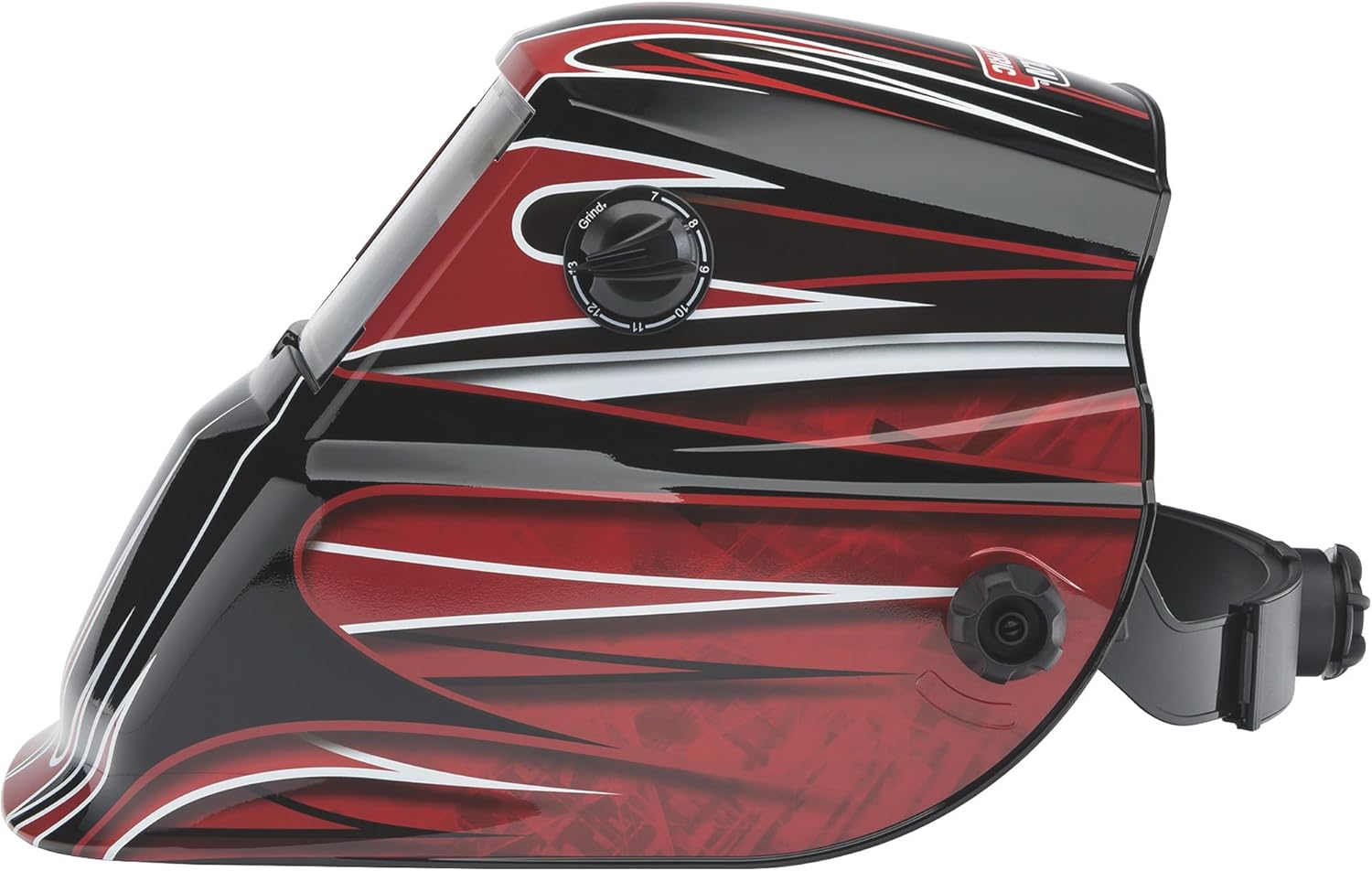
Daim duab 2: Sab view of the helmet, illustrating the headgear adjustment knob on the side for proper fit and balance.
2.2 Auto-Darkening Lens (ADF) Installation/Check
The auto-darkening filter (ADF) is pre-installed. Ensure it is clean and free from damage. This model does not require user-replaceable batteries for the ADF, as it is solar-powered.

Daim duab 3: Sab hauv view of the Auto-Darkening Filter (ADF) module, showing controls for sensitivity and delay, along with a test button and low battery indicator. This unit is solar-powered and does not require battery replacement.
3. Kev ua haujlwm
This section details how to operate your auto-darkening welding helmet effectively and safely.
3.1 Hwj chim Rau/Tawm
The auto-darkening filter (ADF) is solar-powered and automatically activates when exposed to light. There is no manual on/off switch. Ensure the solar cells on the front of the helmet are not obstructed.
3.2 Shade Adjustment (Variable Shade 7-13)
The helmet features a variable shade range from 7 to 13, allowing you to select the appropriate shade level for different welding processes and amperages. The shade level is adjusted via an external knob.
- Locate the external knob on the side of the helmet.
- Rotate the knob to select the desired shade number (7-13). Refer to welding safety standards for recommended shade levels for your specific application.

Daim duab 4: External control knob for selecting variable shade levels (7-13) and activating grind mode.
3.3 Grind Mode
The helmet includes a grind mode feature, which locks the ADF in a light state (typically shade 3 or 4) for grinding operations. This prevents the lens from darkening, allowing clear vision without removing the helmet, while still providing impact protection.
- Rotate the external knob to the "Grind" position.
- Ensure the lens remains in the light state before beginning grinding.
- Remember to switch back to a welding shade before resuming welding operations.
3.4 Kev hloov kho siab
The sensitivity control adjusts how much light is required to trigger the auto-darkening function. This is useful for different ambient light conditions and welding processes.
- Locate the sensitivity knob on the internal ADF module (refer to Figure 3).
- Turn the knob towards 'H' (High) for lower amperage welding or when working in low ambient light.
- Turn the knob towards 'L' (Low) for high amperage welding or when working in bright ambient light to prevent false triggering.
3.5 Delay Adjustment
The delay control determines how long the lens stays dark after the welding arc extinguishes. This prevents eye fatigue from residual glow and protects against bright flashes from adjacent welding operations.
- Locate the delay knob on the internal ADF module (refer to Figure 3).
- Set a shorter delay for tack welding or when moving quickly between welds.
- Set a longer delay for high amperage welding or when the weld puddle remains bright for an extended period.
3.6 Test Function
The ADF module includes a test button to verify the auto-darkening function before welding. Pressing this button should momentarily darken the lens to the selected shade level.
- Press the "TEST" button on the internal ADF module (refer to Figure 3).
- The lens should darken and then return to its light state. If it does not, refer to the Troubleshooting section.

Daim duab 5: The Lincoln Electric Auto-Darkening Welding Helmet K3063-1 in use during a welding application, demonstrating proper eye and face protection.
4. Kev tu
Regular maintenance ensures the longevity and proper function of your welding helmet.
4.1 Cleaning the Helmet
- Helmet Shell: Clean the helmet shell with a mild soap and water solution. Avoid harsh solvents or abrasive cleaners.
- Outer Cover Lens: Wipe the outer cover lens with a soft, clean cloth. If heavily scratched or pitted, replace it immediately.
- Inner Cover Lens: Clean the inner cover lens with a soft, clean cloth. Replace if scratched or damaged.
- Auto-Darkening Filter (ADF): Gently wipe the ADF surface with a soft, dry cloth. Do not use cleaning solutions on the ADF itself. Ensure the solar cells are clean and unobstructed.
4.2 Replacing Cover Lenses
Cover lenses protect the ADF from sparks and spatter. Replace them regularly when they become scratched, pitted, or dirty to maintain clear vision.
- Carefully remove the retaining frame or clips holding the cover lens in place.
- Remove the old cover lens.
- Insert a new, clean cover lens, ensuring it is properly seated.
- Reinstall the retaining frame or clips securely.
4.3 Cia khoom
Store the helmet in a clean, dry place away from direct sunlight, extreme temperatures, and corrosive materials. Protect the ADF from impact and scratches.
5. Kev daws teeb meem
If you encounter issues with your welding helmet, refer to the following common problems and solutions.
| Teeb meem | Ua Tau | Kev daws |
|---|---|---|
| Lens does not darken when arc is struck. |
|
|
| Lens flickers or darkens intermittently. |
|
|
| Poor visibility through the lens. |
|
|
| Helmet is uncomfortable or unstable. |
|
|
6. Cov lus qhia tshwj xeeb
Key technical specifications for the Lincoln Electric Auto-Darkening Welding Helmet K3063-1.
- Qauv: K3063-1
- Hom Tshuaj: Lincoln Electric
- ViewHauv cheeb tsam: 1.73 x 3.82 po
- Variable Shade Range: 7-13 : kuv
- Lub teeb lub xeev: (Typically Shade 3 or 4 in Grind Mode)
- Lub zog Source: Solar-powered (no user-replaceable batteries required)
- Khoom siv: Polycarbonate (PC)
- Yam khoom hnyav: Approximately 0.01 Ounces (Note: This weight appears to be a data entry error. Actual helmet weight is typically much higher.)
- Khoom Dimensions: Kwv yees li 10 x 10 x 10 nti
- UPC: 015082913339
- Tshwj xeeb nta: Lightweight, Grind Mode, Adjustable Sensitivity, Adjustable Delay
7. Warranty Information
According to the product information, this item comes with Tsis muaj warranty. Please refer to your point of purchase for their return or exchange policies if applicable.
8. Cov neeg siv khoom txhawb nqa
For further assistance, technical questions, or to inquire about replacement parts, please contact Lincoln Electric customer service. You can typically find contact information on the official Lincoln Electric website los yog los ntawm koj lub khw muag khoom.
Cov ntaub ntawv online: Visit the official Lincoln Electric website rau cov khoom siv phau ntawv, FAQs, thiab txhawb kev tiv tauj cov ntsiab lus.