
EBYTE RS232
E90-DTU-433L30 Wireless Transceiver
Cov neeg siv phau ntawv
1. Khoom Tshajview
The E90-DTU-433L30 is a high-performance wireless data transceiver designed for reliable long-range communication. Operating within the 410-441MHz frequency range with a power output of 30dBm, it can achieve communication distances up to 8.0km. This device integrates digital data processing, modulation, demodulation, and error correction (FEC) to provide a transparent RS232/RS485 interface, distinguishing it from traditional analog FM transceivers.

Daim duab 1: Pem hauv ntej view of the E90-DTU-433L30 Wireless Transceiver, showing RS232, RS485, GND, VCC ports, PWR, TXD, RXD indicators, M0, M1 pins, DC-IN, and antenna connector.
2. Cov yam ntxwv tseem ceeb
- Advanced LoRa Modulation: Utilizes military-grade LoRa modulation technology for enhanced communication distance and stability.
- High Power Output: Transmission power up to 1W, with multi-level adjustable settings, meeting European industrial standards.
- Wide Interface Support: Provides transparent RS232 and RS485 interfaces for versatile connectivity.
- Robust Design: All-aluminum alloy shell for compact size, easy installation, good heat dissipation, and excellent electromagnetic compatibility.
- Txhim khu kev ntseeg tau: Features power reverse connection protection, over-connection protection, and antenna surge protection.
- Flexible Power Supply: Supports 10-28V power supply, compatible with various power devices or line pressure modes.
- Precise Frequency Stability: Incorporates temperature compensators for frequency stability better than ±1.5PPM.
- Configurable Parameters: All parameters such as power, frequency, air speed, and address ID can be set via programming software.
- Kev siv hluav taws xob tsawg: Standby current is only 21mA (even lower in power-saving and sleep modes).
- Built-in Watchdog: Ensures automatic module restart in case of exceptions, maintaining continuous operation with previous settings.
3. Kho vajtse Tshajview
The E90-DTU-433L30 features clearly labeled interfaces and indicators for easy setup and monitoring.

Daim duab 2: Paub meej view of the transceiver's hardware components, including Antenna Interface, Dip Switch, Power Interface, Function Indicators (PWR, TXD, RXD), RS485 terminals, and RS232 port.
- Antenna Interface: SMA-K connector for external antenna connection.
- Dip Switch (M0, M1): Used to set the module's operating mode (e.g., normal, wake-up, power-saving, configuration).
- Power Interface (DC-IN): Input for 10-28V DC power supply.
- Function Indicators:
- PWR: Lub zog ntsuas.
- TXD: Transmit data indicator.
- RXD: Receive data indicator.
- RS485 interface: Screw terminals for RS485_A, RS485_B, GND, and VCC connections.
- RS232 interface: DB9 serial port for RS232 communication.
4. Setup and Basic Function
The E90-DTU-433L30 facilitates transparent data transmission between devices using RS232 or RS485 interfaces.
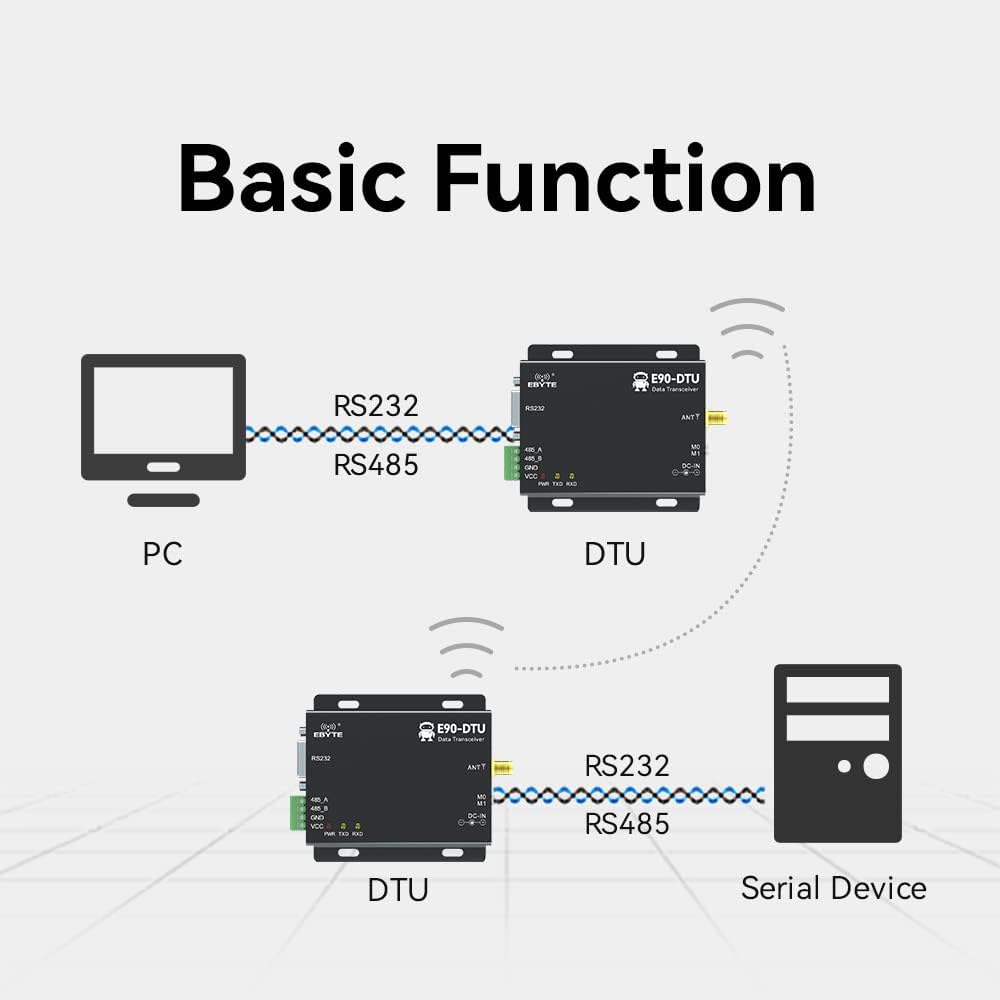
Figure 3: Diagram illustrating typical connections: a PC connected to one DTU via RS232/RS485, and another DTU connected to a serial device via RS232/RS485, communicating wirelessly.
4.1. Kev teeb tsa thawj zaug
- Txuas Antenna: Securely attach the 433MHz antenna to the SMA-K connector.
- Kev sib txuas fais fab: Connect a 10-28V DC power supply to the DC-IN port. Ensure correct polarity.
- Kev sib txuas ntawm Data Interface:
- For RS232: Connect your device (e.g., PC) to the DB9 RS232 port using a serial cable.
- For RS485: Connect your device to the RS485_A and RS485_B terminals. Ensure proper A/B wiring.
- Mode Configuration: Set the M0 and M1 dip switches according to your desired operating mode (e.g., transparent transmission, configuration mode). Refer to the detailed technical manual for specific mode settings.
4.2. Software Configuration
The E90-DTU-433L30 supports software configuration for various parameters, including frequency, air speed, and address ID.

Fig 4: Example interface of the Function Configuration Software, available for download from the official webqhov chaw.
It is recommended to download and use the official configuration software to customize the module's settings to match your application requirements. This software allows for precise control over the transceiver's operational parameters.
5. Kev ua haujlwm
Once properly configured and connected, the E90-DTU-433L30 operates as a transparent data link. Data sent to its RS232 or RS485 port will be wirelessly transmitted to a paired E90-DTU module, and vice-versa.
- Kev xa cov ntaub ntawv: When data is received on the serial input (RS232/RS485), the module automatically modulates and transmits it wirelessly. The TXD indicator will flash.
- Data Reception: Upon receiving wireless data, the module demodulates it and outputs it through the serial interface. The RXD indicator will flash.
- Hom Kev Tswj: Ensure both transmitting and receiving modules are set to compatible operating modes (e.g., transparent transmission mode) for seamless communication.
6. Kev qhia tshwj xeeb
| Specification | Tus nqi |
|---|---|
| ASIN | B07R51G2CD |
| Yam khoom naj npawb | TSI RS232 |
| Hom | EBYTE |
| Tag nrho Ethernet Ports | 2 |
| Tus naj npawb ntawm cov chaw nres nkoj | 2 |
| Maximum Upstream Data Transfer Rate | 433 MHz |
| Hom Hom | Digital |
| Chaw tsim tshuaj paus | EBYTE |
| Hnub Ua Ntej Muaj | Cuaj hlis 27, 2021 |

Figure 5: Physical dimensions of the E90-DTU-433L30 module, approximately 82mm in length and 62mm in width.
7. Tej kev siv
The E90-DTU-433L30 is suitable for a wide range of applications requiring reliable wireless data transmission.

Fig 6: Examples of application environments: Smart home, Agricultural application, Intelligent warehouse, Industrial applications, Device management, and general Wireless data transmission.
- Ntse Tsev Systems
- Agricultural Monitoring and Control
- Intelligent Warehouse Management
- Industrial Automation thiab Tswj
- Kev tswj cov chaw taws teeb
- General Wireless Data Transmission
8. Kev tu
To ensure the longevity and optimal performance of your E90-DTU-433L30 transceiver, follow these maintenance guidelines:
- Khaws huv si: Regularly clean the exterior of the module with a soft, dry cloth. Avoid using harsh chemicals or abrasive materials.
- Ib puag ncig tej yam kev mob: Ua haujlwm lub module hauv nws qhov kub thiab txias uas tau teev tseg. Tsis txhob raug rau qhov kub thiab txias heev, tshav ntuj ncaj qha, lossis dej noo ntau.
- Kev sib txuas ruaj ntseg: Periodically check all cable connections (power, serial, antenna) to ensure they are secure and free from damage.
- Hloov tshiab Firmware: Xyuas cov chaw tsim khoom website for any available firmware updates that may improve performance or address issues.
- Kev kho kom raug: Handle the module with care to prevent physical damage. Avoid dropping or subjecting it to strong vibrations.
9. Kev daws teeb meem
If you encounter issues with your E90-DTU-433L30, consider the following troubleshooting steps:
- Tsis muaj zog:
- Tshawb xyuas lub hwj huam mov voltage is within the 10-28V DC range.
- Check power cable connections and ensure they are secure and correctly polarized.
- Confirm the power outlet or source is functional.
- Tsis muaj kev sib txuas lus:
- Ensure both transmitting and receiving modules are powered on and their PWR indicators are lit.
- Check serial cable connections (RS232/RS485) for proper wiring and secure fit.
- Verify that the M0 and M1 dip switch settings on both modules are identical and configured for the desired operating mode (e.g., transparent transmission).
- Confirm that the frequency, air speed, and address ID settings are consistent across all communicating modules using the configuration software.
- Check antenna connections and ensure antennas are properly installed and not obstructed.
- Reduce the distance between modules or remove obstacles if communication range is an issue.
- Kev sib txuas lus tsis sib xws:
- Check for sources of electromagnetic interference (EMI) near the modules.
- Xyuas kom lub hwj huam mov ruaj khov thiab tsis muaj kev hloov pauv.
- Verify antenna integrity and placement.
- Module Not Responding to Software:
- Ensure the module is in configuration mode (check M0/M1 settings).
- Verify the correct COM port is selected in the software.
- Check the serial cable and drivers on your computer.
10. Kev them nyiaj yug thiab Resources
For detailed technical documentation, software downloads, and further support, please refer to the official EBYTE resources:
- Technical Manual Support: http://www.ebyte.com/en/product-view-news.aspx?id=418
- Chaw tsim tshuaj paus: EBYTE
- Official Webqhov chaw: Visit the EBYTE official website for the latest product information, drivers, and software.
11. Warranty Information
Specific warranty terms and conditions for the E90-DTU-433L30 Wireless Transceiver are typically provided at the point of purchase or can be found on the official EBYTE website. Please retain your proof of purchase for any warranty claims. For detailed warranty policy, please consult the manufacturer's official documentation or contact EBYTE customer support directly.
Ask a question about this manual
Ask about setup, troubleshooting, compatibility, parts, safety, or missing instructions. Manuals+ will review the question and use this page’s manual context to help answer it.