
1. Taw qhia
The ORIVISION EHV1401 is a versatile HDMI and VGA video encoder designed for professional video streaming and broadcasting applications. It supports H.265 and H.264 video encoding at resolutions up to 1080P@60Hz, offering multi-channel output and various streaming protocols. This manual provides detailed instructions for setting up, operating, and maintaining your encoder.
2. Cov yam ntxwv tseem ceeb
- Supports H.265/H.264 video encoding.
- Adaptive selection for HDMI or VGA input.
- Simultaneous HDMI and VGA loop-out display.
- Supports 1x HDMI and 1x VGA input with corresponding loop-out.
- Digital and analog audio loop-out support.
- Wide protocol support: HTTP, HTTPS, RTSP, RTMP, RTMPS, SRT, UDP, RTP, HLS, FLV, Onvif.
- Up to 1080P@60Hz resolution input and output.
- Supports 4 channels of simultaneous stream output.
- Audio encoding without video input capability.
- Two-way audio transmission support.
- AAC/G.711 advanced audio coding format.
- 1000M full-duplex network interface for LAN and WAN transmission.
- Supports POE power supply (optional).
- SDK support for secondary development.
- Network remote management and upgrade capabilities.
- Tsim los rau kev ua haujlwm 24/7.
3. Khoom Tshajview and Interfaces
The ORIVISION EHV1401 encoder features multiple input and output ports for flexible connectivity. Understanding these interfaces is crucial for proper setup.

Daim duab 3.1: Front panel of the ORIVISION EHV1401 encoder. From left to right, it shows VGA input, HDMI input, Audio input, Audio output, VGA output, HDMI output, LAN port, and 12V DC power input.
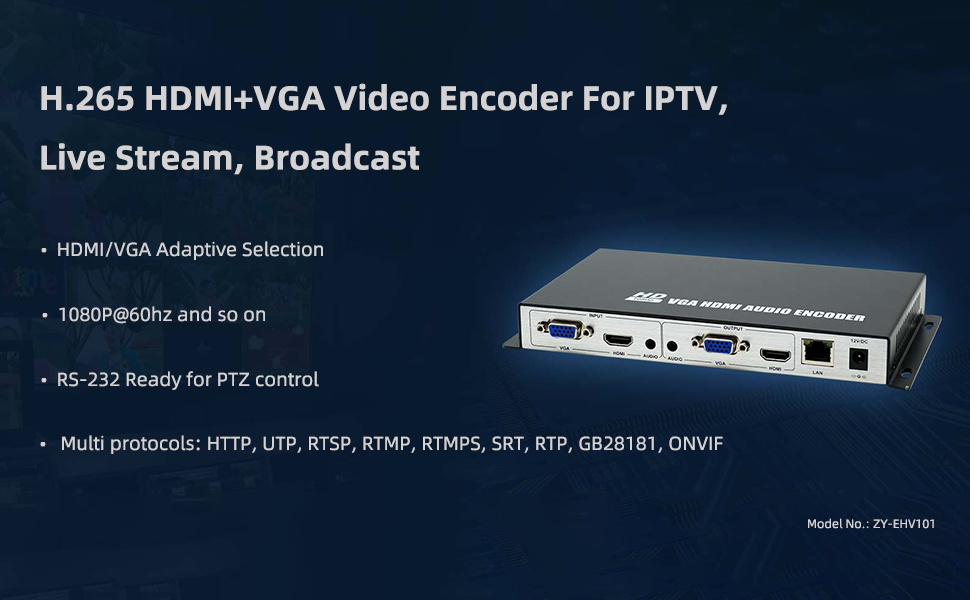
Daim duab 3.2: Tshajview of the ORIVISION EHV1401 encoder highlighting its primary applications for IPTV, Live Stream, and Broadcast, along with key features like adaptive input, 1080P@60Hz support, RS-232 for PTZ, and multiple protocols.
4. Kev teeb tsa thiab kev sib txuas
Follow these steps to connect your ORIVISION EHV1401 encoder to your video sources, displays, and network.
- Txuas Video Source: Connect your HDMI or VGA video source (e.g., PC, camera, monitor, DVD player) to the corresponding HDMI or VGA input port on the encoder.
- Connect Audio Source (Optional): If using external audio, connect your audio source to the Audio input port.
- Connect Local Displays (Loop-out): For local monitoring, connect HDMI or VGA displays to the HDMI Loopout and VGA Loopout ports.
- Kev sib txuas Network: Connect an Ethernet cable from the encoder's LAN port to your network router or switch.
- Kev sib txuas fais fab: Connect the 12V DC power adapter to the encoder's 12VDC port and plug it into a power outlet. If using POE (Power over Ethernet), ensure your network switch supports POE and connect the Ethernet cable.

Daim duab 4.1: Basic connection diagram illustrating how to connect video sources (PC, camera, monitor, DVD), local loop-out displays, and network for streaming to various platforms.
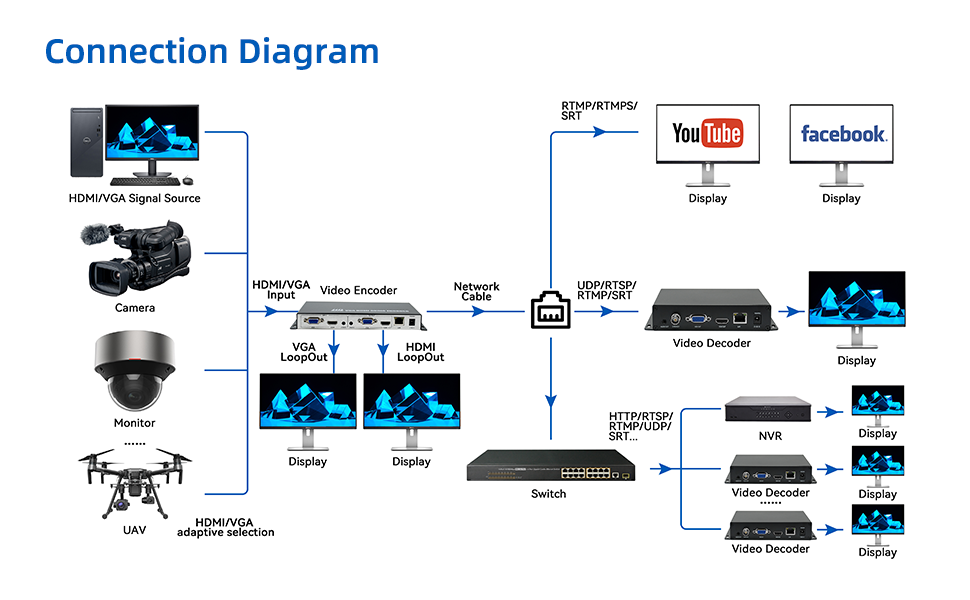
Daim duab 4.2: Advanced connection diagram showing integration with multiple signal sources, local displays, network switches, and various streaming/recording destinations including YouTube, Facebook, video decoders, and NVRs.
5. Cov lus qhia ua haujlwm
Once the encoder is connected, you can configure and manage it via its web interface.
5.1 Nkag mus rau lub Web Interface
- Ensure your computer is on the same network as the encoder.
- Qhib a web browser and enter the encoder's IP address (refer to your network settings or default IP if provided in documentation).
- Log in using the provided credentials (default username/password are usually 'admin'/'admin' or similar, check product documentation).

Daim duab 5.1: Example screenshot of the encoder's web interface, providing access to system information and configuration settings.
5.2 Configuring Video and Audio Settings
- Navigate to the "Encoder" or "Video Settings" section in the web interface.
- Select your desired input source (HDMI or VGA).
- Configure video resolution (up to 1080P@60Hz), frame rate, and bitrate.
- Adjust audio encoding settings (AAC/G.711) and bitrate.
Daim duab 5.2: The encoder supports AAC and G.711 audio encoding for high-quality audio transmission.
5.3 Streaming Configuration
The encoder supports various streaming protocols. Configure your desired protocol and destination.

Daim duab 5.3: The encoder supports a wide range of streaming protocols including RTMP, RTMPS, RTSP, SRT, HLS, UDP/RTP, Multicast, HTTP, and Onvif.
- Select the streaming protocol (e.g., RTMP for YouTube/Facebook Live).
- Enter the streaming server URL and stream key/name provided by your streaming platform.
- Save your settings and start the stream.
6. Cov lus qhia tshwj xeeb
Detailed technical specifications for the ORIVISION EHV1401 encoder (Model ZY-EHV101).

Daim duab 6.1: Comprehensive specifications table for the ZY-EHV101 model, detailing video input/output, supported resolutions, encoding, audio interfaces, network features, and general device parameters.
| Qeb | Parameter | Tus nqi |
|---|---|---|
| Video | Input Interfaces | 1x HDMI 1.4 and VGA (HDCP1.4) |
| Txhawb kev daws teeb meem | 1920*1080, 1280*720, 1280*800, 1280*768, 1024*768, 1024*576, 960*540, 850*480, 800*600, 720*576, 720*540, 720*480, 720*404, 704*576, 640*480, 640*360, 480*270, Auto | |
| Ncej tus nqi | 5-60Hz | |
| Tso zis interfaces | 1x Ethernet port (RJ45), 1x HDMI and VGA Loop-out | |
| Video encoding | H.265 & H.264 | |
| Tus lej Code | 16kbps - 12Mbps | |
| Suab | Input interfaces | 1x External audio, HDMI and VGA built-in Audio |
| Tso zis interfaces | 1x External audio | |
| Audio encoding | AAC, G.711 | |
| Network | RJ 45 | 1000M Ethernet chaw nres nkoj |
| Program Streaming | HTTP, RTSP, RTMP/RTMPS, SRT, GB28181, HLS, FLV, ONVIF, Multicast: UDP/RTP | |
| General | Dimension (W*L*H) | 8.5*4.4*0.98in (217*112*25mm) |
| Qhov hnyav tag nrho | 0.35kg ib | |
| Kub | 0 ~ 45°C (for working), -20~60°C (for storing) | |
| Cov av noo | <90%, tsis-condensing | |
| Cov lus qhia Voltage | DC 12V / 1A | |
| Kev siv fais fab | 5W |

Daim duab 6.2: Physical dimensions of the ORIVISION EHV1401 encoder.
7. Kev daws teeb meem
This section addresses common issues you might encounter with your ORIVISION EHV1401 encoder.
- Tsis muaj Video tso zis:
- Check all HDMI/VGA cable connections. Ensure they are securely plugged in.
- Verify the input source is active and outputting a signal.
- Confirm the resolution and refresh rate of the input source are supported by the encoder (refer to specifications).
- Ensure the correct input source is selected in the encoder's web interface.
- Tsis muaj Network Txuas:
- Check the Ethernet cable connection to the encoder and your network device.
- Verify network settings (IP address, subnet mask, gateway) in the encoder's web interface.
- Ensure your network router/switch is functioning correctly.
- Streaming Issues (Buffering, Disconnections):
- Check your internet connection speed and stability.
- Reduce the video bitrate in the encoder settings if your internet upload speed is insufficient.
- Verify the streaming server URL and stream key/name are correct.
- Ensure no firewall or network security settings are blocking the streaming protocols.
- Tsis muaj suab:
- Check audio cable connections (if using external audio).
- Ensure audio is enabled and correctly configured in the encoder's web interface.
- Verify the audio source is active and producing sound.
8. Kev tu
Proper maintenance ensures the longevity and optimal performance of your ORIVISION EHV1401 encoder.
- Ntxuav: Siv daim ntaub mos mos thiab qhuav los ntxuav sab nraud ntawm lub cuab yeej. Tsis txhob siv cov tshuaj ntxuav uas muaj kua los yog cov khoom siv uas ua rau tawv.
- Qhov cua: Ensure the encoder is placed in a well-ventilated area to prevent overheating. Do not block ventilation openings.
- Hloov tshiab Firmware: Periodically check the ORIVISION weblub vas sab rau kev hloov kho firmware. Kev hloov kho firmware kom zoo tuaj yeem txhim kho kev ua tau zoo thiab ntxiv cov yam ntxwv tshiab.
- Cia: If storing the device for an extended period, ensure it is kept in a cool, dry place within the specified storage temperature range (-20~60°C).
9. Warranty thiab Support
For warranty information and technical support, please refer to the documentation included with your purchase or visit the official ORIVISION website. You can also contact ORIVISION customer service for assistance with product setup, operation, or troubleshooting.
Chaw tsim tshuaj paus: Nantong ZYDZ Electronic Co.,Ltd.
Hom Tshuaj: ORIVISION