
1. Taw qhia
This manual provides essential instructions for the safe installation, operation, and maintenance of your PAL Lighting 500W Multi-Color Dual Zone Remote Control LED Controller, model PCR-3D-500. This unit is designed to power and control multi-color LED lighting systems, typically used in pool and spa environments, offering dual-zone control for enhanced lighting customization. Please read this manual thoroughly before installation and use, and retain it for future reference.
2. Cov ntaub ntawv kev nyab xeeb
- Hluav Taws Xob Hluav Taws Xob: Installation must be performed by a qualified electrician in accordance with all national and local electrical codes. Ensure power is disconnected at the circuit breaker before any installation or maintenance.
- Dej thiab noo noo: The controller unit has an IP65 rating, indicating protection against dust and low-pressure water jets. However, it is not designed for submersion. Ensure the unit is mounted in a location that prevents direct exposure to heavy rain or standing water.
- Voltage Compatibility: This unit operates with a supply voltage of 100-240V (50/60Hz) and provides a 24V DC output. Verify that your lighting system is compatible with 24V DC.
- Kev tiv thaiv overload: Do not exceed the maximum output power of 500 Watts. Overloading the unit can cause damage and create a fire hazard.
- Qhov cua: Ensure adequate ventilation around the unit to prevent overheating. Do not cover the controller.
- Me Nyuam thiab Tsiaj Tsiaj: Keep the unit and its remote control out of reach of children and pets.
3. Cov ntsiab lus ntawm pob
Xyuas kom tseeb tias tag nrho cov khoom tam sim no thiab tsis muaj kev puas tsuaj thaum unpacking:
- PAL Lighting PCR-3D-500 LED Controller Unit
- PAL PCZ-2 Color Touch 2 Zone Remote Control
- Instruction Manual (cov ntaub ntawv no)
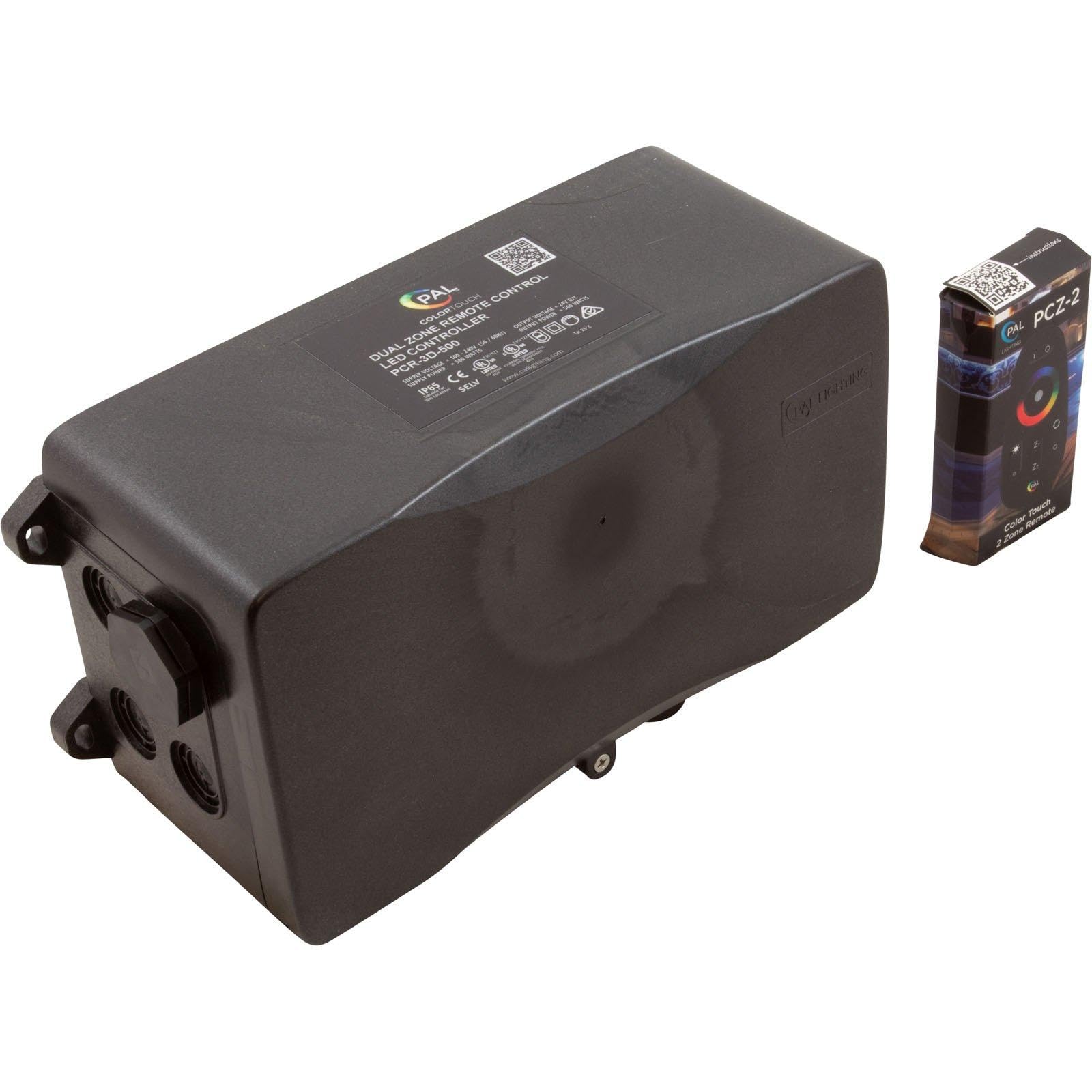
Image 1: The PAL Lighting PCR-3D-500 LED Controller unit (left) and the PAL PCZ-2 Color Touch 2 Zone Remote Control (right). The controller unit is a black rectangular box with connection ports, and the remote is a small, black, rectangular device with a color wheel and buttons.
4. Cov lus qhia tshwj xeeb
| Qauv | PCR-3D-500 |
| Tshooj Naj Npawb | 64-PCR-3D-500 |
| Hom | PAL Lighting |
| Muab Voltage | 100-240V AC, 50/60Hz |
| Tso zis Voltage | 24v dc ua |
| Muab Lub Zog | 550 Watts |
| Tso zis zog | 500 Watts |
| Kev ntsuas IP | IP65 |
| Mounting Hom | Phab ntsa Mount |
| Yam Nyhav | 4 phaus (kwv yees 1.8 kg) |
| Chaw tsim tshuaj paus | PAL Teeb pom kev zoo LLC |
5. Kev teeb tsa thiab kev teeb tsa
Tseem ceeb: Installation should only be performed by a qualified professional electrician. Ensure all power is disconnected before beginning installation.
- Xaiv qhov chaw Mounting: Select a suitable wall-mount location that is easily accessible for wiring, protected from direct heavy weather, and allows for adequate ventilation. The IP65 rating provides protection against dust and water jets, but avoid areas prone to submersion or constant heavy water exposure.
- Mount lub Controller: Securely mount the PCR-3D-500 unit to a sturdy surface using appropriate fasteners. Ensure the unit is level.
- Input Power Wiring: Connect the main power supply (100-240V AC, 50/60Hz) to the designated input terminals on the controller. Follow local electrical codes for wiring practices, including proper grounding.
- Output Wiring to Lights: Connect your 24V DC multi-color LED lights to the output terminals of the controller. Ensure correct polarity (+ and -) for all connections. This unit supports dual zones; connect lights for each zone to their respective output terminals. Do not exceed the total 500W output capacity.
- Tshawb xyuas kev sib txuas: Double-check all wiring connections for security and correctness before restoring power.
- Rov Qab Fais Fab: Once all connections are verified and secure, restore power to the circuit.

Image 2: Ib qho kev kaw view of the PAL Lighting PCR-3D-500 LED Controller, highlighting the sealed wiring ports on the side, designed for secure electrical connections.
6. Cov lus qhia ua haujlwm
The PAL Lighting PCR-3D-500 LED Controller is operated using the included PAL PCZ-2 Color Touch 2 Zone Remote Control.
6.1 Remote Control Functions (PAL PCZ-2)
- Fais fab / Off: Nias lub Hwj chim button to turn the connected lights on or off.
- Zone Xaiv: Siv cov Zone 1 thiab Zone 2 buttons to select which lighting zone you wish to control. The selected zone will typically be indicated on the remote.
- Xim xaiv: Cov Color Touch Wheel allows you to select a specific color for your lights. Simply touch the desired color on the wheel.
- Kev hloov Brightness: Siv cov Brightness Up (+) thiab Brightness Down (-) buttons to adjust the intensity of the selected color or lighting mode.
- Hom Kev Xaiv: The remote may include buttons for pre-programmed lighting modes (e.g., Fade, dhia, Strobe). Refer to the remote's specific instructions for detailed mode descriptions.
- Kev hloov ceev: For dynamic lighting modes, Ceev ceev thiab Ceev Ceev buttons may be available to control the transition speed.
Ensure the remote control has fresh batteries and is within operational range of the controller unit for reliable performance.
7. Kev tu
- Ntxuav: Periodically clean the exterior of the controller unit with a soft, damp daim ntaub. Tsis txhob siv cov tshuaj abrasive los yog cov kuab tshuaj. Xyuas kom lub tsev raug kaw ua ntej ntxuav.
- Kev tshuaj xyuas: Regularly inspect the wiring connections for any signs of wear, corrosion, or damage. Ensure all connections remain secure.
- Qhov cua: Keep the area around the controller clear of obstructions to ensure proper airflow and prevent overheating.
- Chaw taws teeb tswj roj teeb: Replace the remote control batteries when performance degrades or it stops responding. Refer to the remote's specific instructions for battery type and replacement procedure.
8. Kev daws teeb meem
| Teeb meem | Ua Tau | Kev daws |
|---|---|---|
| Lub teeb tsis tig. | Tsis muaj hwj chim rau tus maub los. Faulty thaiv kev sib txuas. Roj teeb tswj chaw taws teeb tuag lawm. Lights are faulty. | Tshawb xyuas lub tshuab hluav taws xob thiab lub hwj chim. Inspect all wiring connections for security and correctness. Hloov cov roj teeb tswj chaw taws teeb. Test lights with a known working power source if possible. |
| Lights are not responding to remote control. | Remote control battery is low or dead. Tej thaj chaw deb yog tawm ntawm qhov ntau. Kev cuam tshuam. Remote not paired (if applicable). | Hloov cov roj teeb tswj chaw taws teeb. Move closer to the controller unit. Ensure no large metal objects or other wireless devices are interfering. Refer to remote instructions for pairing procedure if necessary. |
| Cov teeb ci ntsa iab lossis hloov xim tsis tu ncua. | Loose thaiv kev sib txuas. Overloaded Circuit Court. Faulty lights or controller. | Tshawb xyuas thiab ruaj ntseg txhua qhov kev sib txuas ntawm cov kab txuas. Xyuas kom tag nrho wattage of connected lights does not exceed 500W. Contact support if problem persists after checking connections and load. |
| Only one zone is working. | Incorrect zone selection on remote. Wiring issue for the non-working zone. Faulty lights in the non-working zone. | Ensure the correct zone is selected on the remote. Inspect wiring for the non-working zone. Test lights in the non-working zone. |
If troubleshooting steps do not resolve the issue, contact PAL Lighting customer support.
9. Warranty thiab Support
This product is manufactured by PAL Lighting LLC. For warranty information, technical support, or service inquiries, please contact PAL Lighting directly.
Chaw tsim tshuaj paus: PAL Teeb pom kev zoo LLC
Webqhov chaw: www.palighting.com
Please have your model number (PCR-3D-500) and purchase date available when contacting support.