
Hasaller TOWSPE-D20
Hasaller Household Surge Protector User Manual
Hom Tshuaj: Hasaller | Qauv: TOWSPE-D20 (KF6F3T8S4DH2B864S5B3)
1. Taw qhia
This user manual provides essential information for the safe and effective installation, operation, and maintenance of your Hasaller Household Surge Protector. This device is designed to protect your electrical systems and connected equipment from transient overvoltages (surges) caused by lightning strikes or switching operations. Please read this manual thoroughly before installation and keep it for future reference.
2. Cov ntaub ntawv kev nyab xeeb
CEEB TOOM: Electrical installation should only be performed by qualified and licensed electricians in accordance with all local and national electrical codes and regulations. Failure to do so may result in electric shock, fire, serious injury, or death.
- Always disconnect power to the circuit before installing or servicing the surge protector.
- Do not install this device in wet or damp qhov chaw.
- Xyuas kom tseeb tias kev sib txuas grounding zoo.
- Xyuas kom tseeb tias voltage and current ratings of the surge protector match your electrical system requirements.
- Do not attempt to open or repair the device. Refer servicing to qualified personnel.
3. Khoom Tshajview
3.1 Nta
- Core components are metal oxide varistor (MOV) components with high discharge capacity.
- Offers low residual voltage and fast response time for effective protection.
- Equipped with Thermo Dynamic Control disconnection for enhanced reliability and safety.
- Includes remote signaling contact for external monitoring and notification.
- Clear fault indication via a red mark in the inspection window.
- Protection modes: Line-to-Neutral (L-N) and Neutral-to-Protective Earth (N-PE).
3.2 Cheebtsam
The Hasaller Household Surge Protector is a compact DIN rail mountable device. Key components include:
- L/N Terminals: Input/output terminals for Line and Neutral connections.
- PE Terminal: Terminal for Protective Earth (Ground) connection.
- Inspection Window: Displays the operational status (Green: Normal, Red: Malfunction/Needs Replacement).
- DIN Rail Clip: For secure mounting on a standard DIN rail.
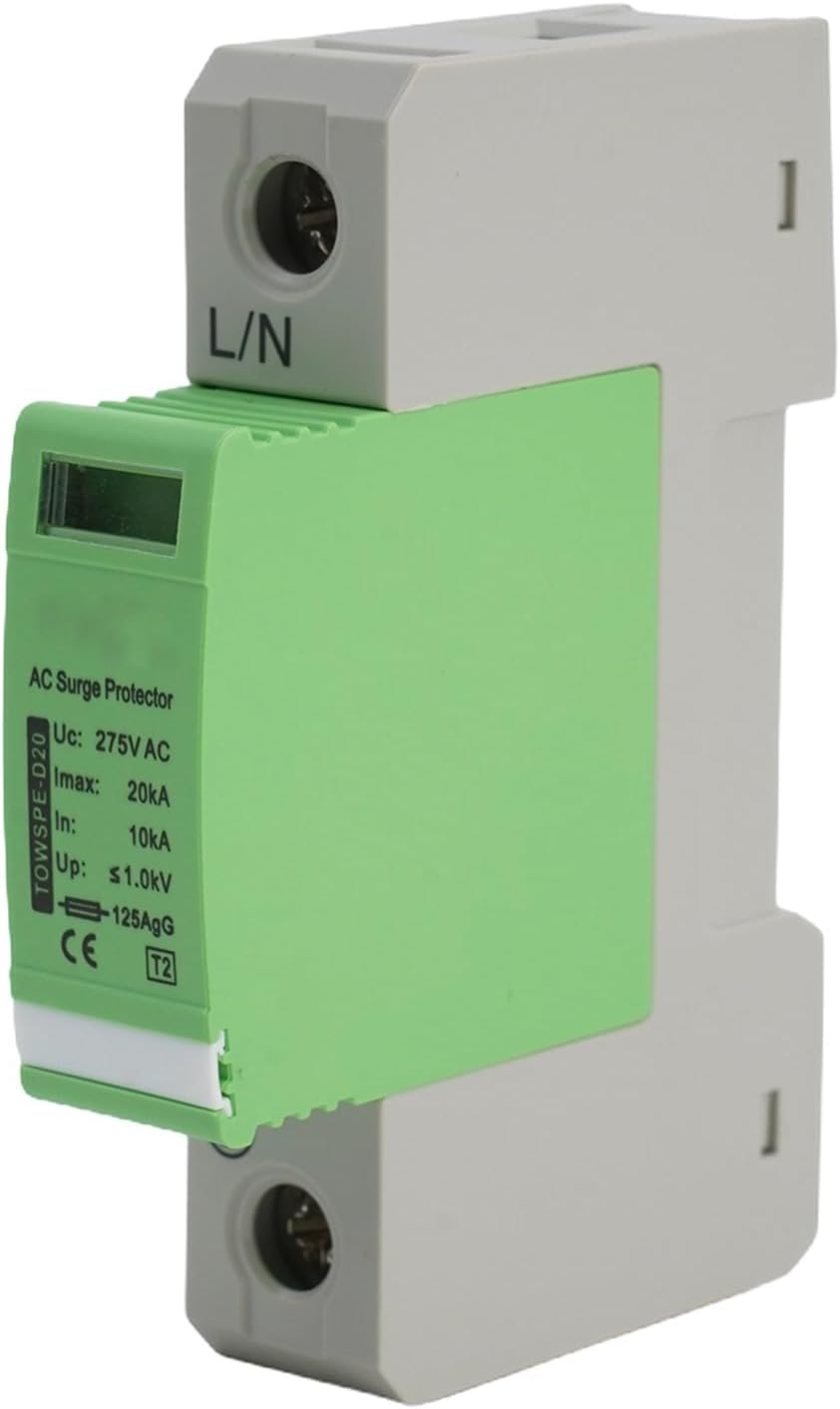
Daim duab 3.2.1: Pem hauv ntej view of the Hasaller Household Surge Protector, showing the L/N terminals, inspection window, and product specifications printed on the side.
3.3 Specifications
| Parameter | Tus nqi |
|---|---|
| Qauv | TOWSPE-D20 |
| Chav kawm tiv thaiv | D |
| Max. Kev ua haujlwm tsis tu ncua Voltage (Uc) | 275V AC lub cev muaj zog |
| Nominal Discharge Current (In, 8/20 µs) | 10k ua |
| Max. Discharge Current (Imax, 8/20 µs) | 20k ua |
| Voltage Kev Tiv Thaiv Qib (Up) | ≤1 KV |
| Teb Sijhawm | <25 os |
| Ua hauj lwm ib puag ncig kub | -40 ° C rau + 80 ° C |
| Working Environment Relative Humidity | <95% |
| Indication of Deterioration | Green (Normal), Red (Malfunction) |
| Khoom Dimensions | 90mm (H) x 50mm (D) x 18mm (W) |

Figure 3.3.1: Dimensional drawing of the surge protector, indicating its height, depth, and width for installation planning.
4. Kev teeb tsa thiab kev teeb tsa
The Hasaller Household Surge Protector is designed for easy installation on a standard 35mm DIN rail within an electrical distribution board or control cabinet. Ensure all power is disconnected before proceeding.
- Fais fab tuag: Turn off the main circuit breaker to completely de-energize the electrical panel where the surge protector will be installed. Verify with a voltage tester that no power is present.
- Mounting: Clip the surge protector onto the DIN rail. Ensure it is securely fastened and does not wobble.
- Kev Txuas Txuas Txuas:
- Connect the Line (L) conductor to the L terminal of the surge protector.
- Connect the Neutral (N) conductor to the N terminal of the surge protector.
- Connect the Protective Earth (PE) conductor to the PE terminal of the surge protector. Ensure this connection is robust and provides a low-impedance path to ground.

Daim duab 4.1: Sab saum toj view illustrating the ground connection terminal for the surge protector.
- Kev txheeb xyuas: Double-check all wiring connections for tightness and correctness. Ensure no bare wires are exposed.
- Lub zog Restoration: Once installation is complete and verified, restore power to the circuit by turning on the main circuit breaker. The inspection window should display "Green" indicating normal operation.
For optimal protection, install the surge protector as close as possible to the incoming power supply or the equipment it is protecting.
5. Cov lus qhia ua haujlwm
The Hasaller Household Surge Protector operates passively, continuously monitoring the electrical system for overvoltage events. It requires no user interaction during normal operation.
- Kev ua haujlwm li qub: When the electrical system is operating within normal voltage parameters, the inspection window on the surge protector will display a Ntsuab indication. This signifies that the device is functioning correctly and providing protection.
- Overvoltage Event: Nyob rau hauv qhov kev tshwm sim ntawm ib tug voltage surge, the surge protector will divert the excess energy to ground, protecting your connected equipment. This process is instantaneous and automatic.
- Fault Indication: If the surge protector has absorbed a significant surge or has reached its end-of-life, the inspection window will change from Ntsuab rau RED. A red indication signifies that the device is no longer providing protection and requires replacement.
6. Kev tu
The Hasaller Household Surge Protector is designed for minimal maintenance. Regular visual inspection is recommended to ensure continued protection.
- Kev tshuaj xyuas qhov muag: Periodically check the inspection window on the front of the device. Ensure it remains Ntsuab.
- Hloov: If the inspection window displays RED, the surge protector has performed its function and is no longer active. It must be replaced immediately to restore protection to your electrical system. Refer to Section 4 for replacement procedures, ensuring power is disconnected first.
- Ntxuav: Yog tias tsim nyog, maj mam so sab nrauv ntawm lub cuab yeej nrog ib daim ntaub qhuav, mos. Tsis txhob siv cov tshuaj ntxuav kua los yog cov kuab tshuaj.
7. Kev daws teeb meem
| Teeb meem | Ua Tau | Kev daws |
|---|---|---|
| Inspection window shows RED. | The surge protector has absorbed a significant overvoltage event or has reached its end-of-life. | The device is no longer providing protection. It must be replaced. Disconnect power and replace the unit following installation instructions. |
| No indication (blank or dark window). | No power to the device, or internal fault. | Verify power supply to the circuit. If power is present and the window is still dark, the device may be faulty and requires replacement. |
| Frequent tripping of circuit breakers after surge protector installation. | Incorrect wiring, faulty device, or persistent overvoltage teeb meem. | Immediately disconnect power. Re-check all wiring connections. If wiring is correct, the device may be faulty and needs replacement. Consult a qualified electrician to assess the electrical system for persistent overvoltage teeb meem. |
If you encounter issues not listed here or are unsure about any troubleshooting steps, please contact a qualified electrician or the manufacturer's support.
8. Warranty thiab Support
For information regarding warranty coverage, technical support, or replacement parts for your Hasaller Household Surge Protector, please refer to the purchase documentation or contact your retailer/seller directly. Keep your proof of purchase for warranty claims.
Chaw tsim tshuaj paus: Hasaller
Qauv nab npawb: KF6F3T8S4DH2B864S5B3
ASIN: B0D6YNXJSZ
Ask a question about this manual
Ask about setup, troubleshooting, compatibility, parts, safety, or missing instructions. Manuals+ will review the question and use this page’s manual context to help answer it.