
Anytone AT-D878UVII
Phau Ntawv Qhia Siv Anytone AT-D878UVII Dual-Band DMR Handheld
Model: AT-D878UVII | Brand: Anytone
1. Taw qhia
The Anytone AT-D878UVII is a versatile dual-band Digital Mobile Radio (DMR) handheld device designed for reliable communication across VHF and UHF frequencies. This manual provides essential information for setting up, operating, maintaining, and troubleshooting your radio to ensure optimal performance.
Key features include dual-mode digital and analog capabilities, a large color display, built-in GPS and APRS TX, and an upgraded USB Type-C rechargeable battery. With 2GB of memory, it supports up to 500,000 digital contacts and 250 zones, each with up to 250 channels. The radio is FCC Part 90 certified, making it suitable for various professional and amateur applications.
2. Cov ntsiab lus ntawm pob
Xyuas kom tseeb tias txhua yam khoom teev hauv qab no suav nrog hauv koj pob:
- Anytone AT-D878UVII Radio Unit
- 3100mAh USB Type-C Battery
- Charging Cradle with Power Supply
- USB Cable (for charging and programming)
- Programming Cable
- Siv tawv Clip
- Lanyard
- Kav hlau txais xov
- Printed User Manual
3. Cheebtsam dhauview
Familiarize yourself with the main components of your AT-D878UVII radio.
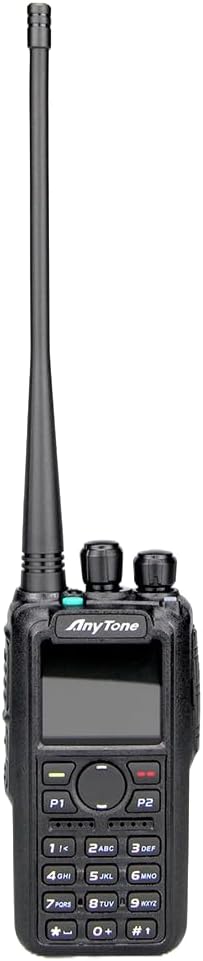
Daim duab 3.1: Pem hauv ntej view of the Anytone AT-D878UVII radio, highlighting the display, keypad, and control knobs.

Figure 3.2: The Anytone AT-D878UVII radio alongside its detached battery, illustrating the USB Type-C charging port on the battery unit.

Daim duab 3.3: Cov ncauj lus kom ntxaws view of the USB Type-C charging port located on the AT-D878UVII battery.
4. Teeb tsa
4.1 Kev teeb tsa thiab kev them nqi roj teeb
- Teem lub roj teeb nrog cov grooves nyob tom qab ntawm lub xov tooj cua.
- Xaub lub roj teeb mus rau pem hauv ntej kom txog thaum nws nyem rau hauv qhov chaw ruaj ntseg.
- To charge, connect the USB Type-C cable directly to the battery's port or place the radio in the charging cradle. The charging indicator will show the status.
4.2 Kav hlau txais xov txuas
- Screw the antenna clockwise into the connector on top of the radio until it is finger-tight. Do not overtighten.
5. Cov lus qhia ua haujlwm
5.1 Lub hwj chim Qhib/Tawm thiab Kev Tswj Suab
- To power on/off, rotate the top-left knob clockwise/counter-clockwise until you hear a click.
- Kho qhov ntim los ntawm kev tig lub pob qhov rooj tib yam.
5.2 Channel Selection (VFO/Memory)
The radio supports both VFO (Variable Frequency Oscillator) mode for direct frequency input and Memory mode for pre-programmed channels.
- Use the navigation buttons or the top-right knob to select channels or adjust frequencies.
- Press the V/M button to switch between VFO and Memory modes.
5.3 DMR and Analog Mode Switching
The AT-D878UVII supports both Digital Mobile Radio (DMR) and traditional Analog communication.
- The radio automatically detects the mode for pre-programmed channels.
- In VFO mode, you can manually select the desired mode through the menu settings.
5.4 GPS and APRS TX
The integrated GPS module allows for location tracking, and APRS TX enables automatic position reporting.
- Access GPS and APRS settings via the main menu to configure reporting intervals and other parameters.
5.5 Programming and Codeplugs
The radio's extensive features are best managed through its Customer Programming Software (CPS). A codeplug is a configuration file that contains all your radio's settings, including channels, zones, contacts, and talkgroups.
For a detailed guide on understanding and creating codeplugs, refer to the video below. While the video demonstrates a similar model, the principles of codeplug creation and management are applicable to your AT-D878UVII.
Video 5.1: An Easy Intro to DMR Codeplugs. This video demonstrates the process of creating and managing codeplugs, a fundamental aspect of configuring your DMR radio. The concepts shown are applicable to the Anytone AT-D878UVII, though a different model is used for demonstration.
5.6 AES256 Encryption
The AT-D878UVII supports AES256 encryption for secure digital communications, primarily for commercial use.
Video 5.2: Digital/Analog Walkie-Talkie with AES256. This video illustrates the AES256 encryption feature, which provides enhanced security for digital transmissions. While a different radio model is shown, the encryption functionality is similar to that found in the Anytone AT-D878UVII.
5.7 Bluetooth PTT Button
The radio includes Bluetooth connectivity, allowing for wireless operation with a Push-To-Talk (PTT) button.
Video 5.3: BTECH DMR-6X2 PRO Feature Highlights. This video demonstrates various features including Bluetooth PTT functionality, which is also available on the Anytone AT-D878UVII for convenient wireless operation.
5.8 Text Messaging
Send and receive text messages over the DMR network.
- Navigate to the 'Messages' option in the main menu to compose, send, and view lus.
5.9 Copying Frequencies
The radio supports copying frequencies and sub-tones from other radios, simplifying channel setup.
Video 5.4: Copy a frequency and sub tone from other radio nearby. This video demonstrates how to quickly copy frequency and sub-tone settings from another radio, a useful feature for rapid channel configuration on your Anytone AT-D878UVII.
6. Kev tu
6.1 Roj Teeb Kho
- Them lub roj teeb tag nrho ua ntej siv thawj zaug.
- Tsis txhob overcharging los yog tag nrho cov roj teeb kom nws lub neej ntev.
- Khaws lub roj teeb rau hauv qhov chaw txias, qhuav thaum tsis siv rau lub sijhawm ntev.
6.2 Kev ntxuav
- So lub xov tooj cua saum npoo nrog lub mos, damp daim ntaub.
- Tsis txhob siv cov tshuaj hnyav los yog cov tshuaj txhuam hniav.
- Xyuas kom lub xov tooj cua qhuav ua ntej siv lossis khaws cia.
7. Kev daws teeb meem
| Teeb meem | Ua Tau | Kev daws |
|---|---|---|
| Xov tooj cua tsis muaj zog | Tsawg los yog roj teeb tuag | Them lub roj teeb kom puv. |
| No audio reception | Volume too low, incorrect frequency/channel, squelch too high | Increase volume, verify frequency/channel, adjust squelch level. |
| Kev xa tsis tau | Incorrect frequency, low battery, transmit inhibit enabled | Verify frequency, charge battery, check programming for transmit inhibit. |
| GPS not acquiring signal | Obstructed view of sky, indoor use | Move to an open outdoor area with clear sky view. |
8. Cov lus qhia tshwj xeeb
| Feature | Paub meej |
|---|---|
| Qauv nab npawb | AT-D878UV II |
| Ntau zaus | 136-174MHz (VHF), 400-480MHz (UHF) |
| Tus naj npawb ntawm Channel | 4000 |
| Digital Contacts | 500,000 |
| Thaj chaw | 250 (up to 250 channels per zone) |
| Roj teeb muaj peev xwm | 3100mAh (USB Type-C) |
| Tshwj xeeb nta | Dual Band, Digital DMR, Analog, GPS, APRS TX, AES256 Encryption |
| Tham ntau yam siab kawg | 5 Miles |
| Yam Nyhav | 2 puj |
| Dej Resistance Level | Tsis Water Resistant |
| Voltage | 12V (DC) |
9. Warranty thiab Support
9.1 Warranty Information
The Anytone AT-D878UVII radio comes with a 1-Year Limited Warranty from the manufacturer, 12 Volt Power. This warranty covers defects in materials and workmanship under normal use. Please retain your proof of purchase for warranty claims.
9.2 Kev Pabcuam Cov Neeg Siv Khoom
For technical assistance, troubleshooting, or warranty inquiries, please contact 12 Volt Power customer support through their official channels. Refer to the product packaging or the manufacturer's website rau cov ntaub ntawv tiv tauj tam sim no.
Ask a question about this manual
Ask about setup, troubleshooting, compatibility, parts, safety, or missing instructions. Manuals+ will review the question and use this page’s manual context to help answer it.